
Protecting your skin from the sun and sunbeds
In Ireland the sun can damage your skin, even on cloudy days. Skin damage does not only happen in hot, sunny places.
Ultraviolet (UV) radiation from the sun and sunbeds can damage skin and increase your risk of skin cancers including:
This is because most skin cancers are caused by UV light damaging the DNA in skin cells. UVA and UVB are types of UV light. They damage skin over time, making it more likely for skin cancers to develop.
Ways to reduce your risk of getting skin cancer
To reduce you or your child's risk of getting skin cancer:
Do
Don't
do not get sunburnt
Follow the SunSmart 5S rule
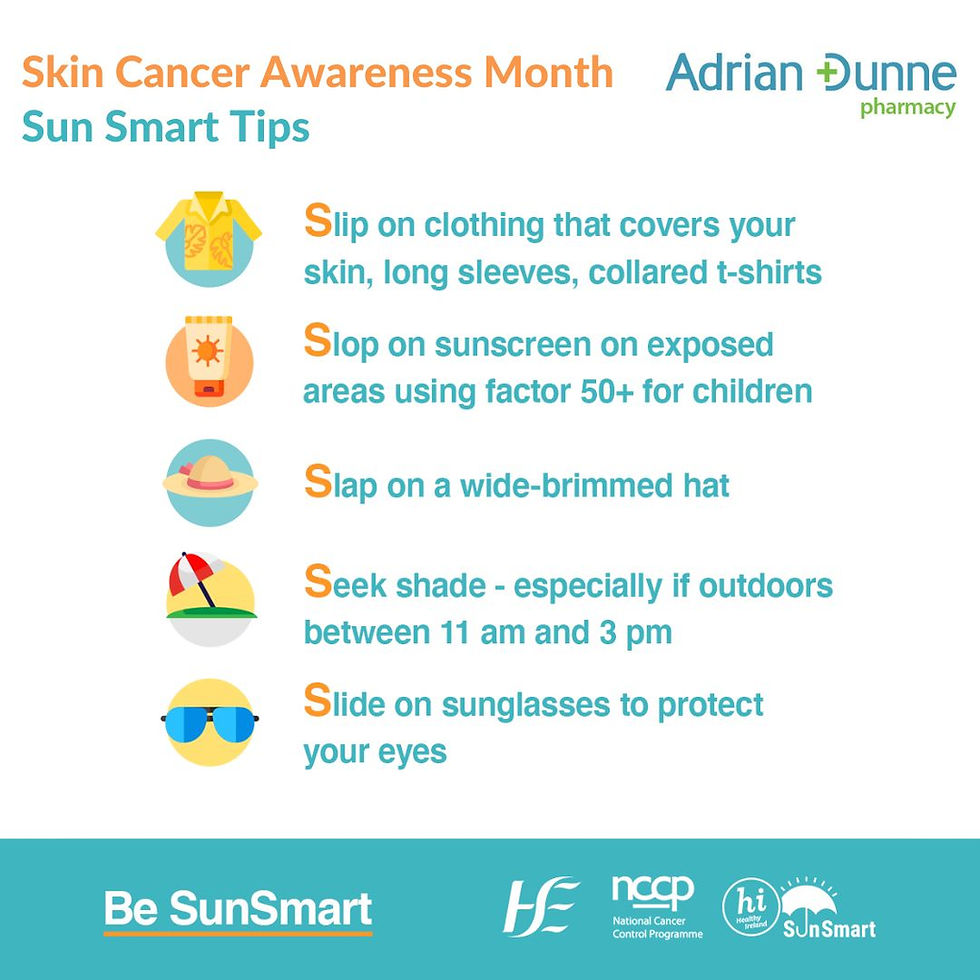
Use the SunSmart 5S rule to remember how to protect your skin from the sun. The 5 parts are slip, slop, slap, seek and slide.
Slip
Slip on clothes that cover your skin, such as long sleeves and t-shirts with a collar.
Slop
Slop on broad-spectrum water-resistant sunscreen. Broad spectrum means the sunscreen protects against UVA and UVB rays.
Choosing sunscreen
There are lots of different types of sunscreen - creams, lotions and sprays.
When buying sunscreen, the label should have a:
sun protection factor (SPF) of at least 30 for adults and 50 for children to protect against UVB
star rating of 4 or more or a UVA logo - these show UVA protection
Make sure the sunscreen is not past its expiry date.
Using sunscreen
Put sunscreen on any skin that you do not cover with clothes.
Do this:
20 minutes before going outdoors
every 2 hours after
after swimming, towel drying
more often than 2 hours if you are sweating
Sunscreen does not give you 100% protection - use it as well as covering your skin with clothes and seeking shade.
Slap
Slap on a wide-brimmed hat to protect your face, ears and neck.
Seek
Seek shade especially if outdoors between 11am and 3pm from April to September when UV from the sun is strongest. Always use a sunshade on a child’s buggy. Keep babies and children out of direct sunlight.
Slide
Slide on wraparound sunglasses with UV protection to protect your eyes.
Check the UV index
The UV index tells you how strong the sun’s UV rays are each day.
You need to protect your skin when the UV index is 3 or above.
In Ireland, the UV index is usually 3 or above from April to September, even when it is cloudy. UV is usually strongest between 11am and 3pm.
Never use a sunbed
A sunbed produces UV rays similar to sunshine, but much stronger. There is no safe way to use a sunbed.
Using sunbeds increases your risk of getting skin cancer. All sunbed users are at risk. It is never OK to use a sunbed.
A sunbed can also age your skin and cause wrinkles and brown spots.
No company can allow you to use a sunbed on a sunbed premises or hire sunbed if you are under 18. It's against the law for anyone under the age of 18 to buy, hire or use a sunbed in Ireland.
Don't
do not use a sunbed to stop you from burning - if your skin burns in the sun it will also burn on a sunbed
do not use a sunbed to treat skin conditions such as acne, eczema or psoriasis - talk to your GP, they can refer you to a dermatologist for advice
do not use a sunbed to increase low vitamin D - find safe ways to increase your vitamin D
Do not try to get a tan
A tan does not protect against sunburn. A tan is a sign that your skin is damaged by UV radiation from the sun or a sunbed. Even when a tan fades, the skin damage caused by the tan never goes away.
Who needs to protect their skin from UV radiation
Everyone needs to protect their skin from UV radiation.
Anyone can get skin cancer but you may be at more at risk if you:
spend a lot of time in the sun
have had a lot of sunburns - especially when you were a child
work outdoors
do outdoor sport and activities
use a sunbed
take medicine that suppresses your immune system
have a condition that suppresses your immune system, such as HIV
have had skin cancer or a close family member has had skin cancer
You are more likely to get skin cancer if you have:
white skin that burns easily
green or blue eyes
red or blonde hair
lots of freckles or moles on your skin
You still need to protect your skin from the sun if you have:
black skin
brown skin
skin that tans easily
skin that does not burn easily
If you have dark brown or black skin your risk of getting skin cancer is lower - but it may be found at a more advanced stage. This means it will be more difficult to treat.
Information:
Babies and children
Playing and spending time outdoors is good for your child. But children’s skin is very sensitive to UV from the sun. Protect their skin, even on cloudy days.
Skin cancer in children is rare but sunburn during childhood increases your risk of getting skin cancer as an adult.
If your child is badly sunburnt more than 3 times before the age of 20, they more than double their risk of skin cancer as an adult.
Teenagers and young people
Teenagers and young people spend more time in the sun than children and older adults.
Skin cancer is rare in teenagers. But sunburn, tanning and spending time outdoors during your teenage years is more likely to lead to skin cancer later in life.
If you are a teenager or young person, make sun protection part of your daily routine.
Outdoor workers
You are more at risk of skin cancer if you spend a lot of time working outdoors.
Outdoor workers include farmers, landscapers and construction workers.
If you work outdoors plan your work so you are in the shade from 11am to 3pm. This is when UV rays are strongest.
You can be exposed to up to 3 times more UV radiation than indoor workers.
People who take part in outdoor sport and activities
You are more at risk of skin cancer if you spend a lot of time outdoors or are involved in outdoor sports, recreation and tourism.
For example, if your hobby is gardening outdoors, or you walk, hike, run, are a sea swimmer, ski, cycle, golf or play tennis.
header.all-comments